Many see this topic as trivial. This is exactly how gender ideology is imposed in society. Magazines can be accused of ‘covert sexism’ which is embedded as presupposition, not statements, making it difficult to challenge. Overt sexism can be challenged easily which is why covert sexism sustains ideology, and how magazines get away with enforcing stereotypes about the way men and women behave. The fact there are magazines ‘for men’, ‘for women’ already perpetuate gender difference ideology. It assumes there are things women do which men do not, vice versa. This reinforces gender stereotypes; there are things men cannot do and things women cannot do. Stereotypes may seem harmless but ‘stereotype embodiment theory’ suggests people incorporate them into self-definitions, influencing people’s behaviour and functioning. Ideology is normative ideas and values in society, seen as common sense, which sustain power relations. Ideologies are embedded in language: there are 220 derogatory words for sexually promiscuous females, and 20 for sexually promiscuous males. This is misogyny through language. Magazine titles are outlets for gender ideology and stereotypes, and analysing them “is an important first step into providing insights into inequality”.
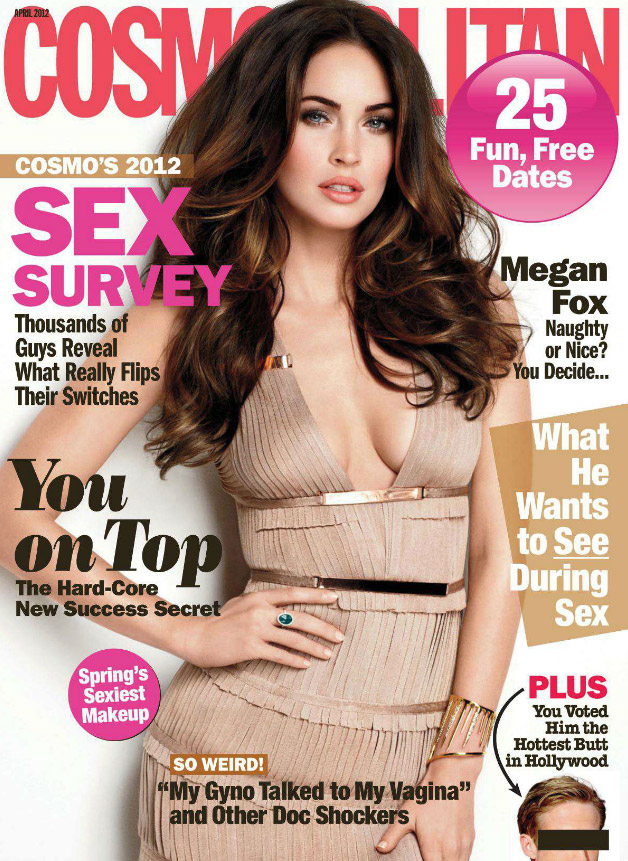
Firstly, let’s look at three covers from magazines ‘for women’:


The covers talk a lot about sex (specifically heterosexual) which is arguably progressive as it encourages women to have better sex rather than shames them for it. However, it is mostly spoken about in order to please a man. In fact, the female reader’s pleasure is almost secondary: ‘…and yours’. Robin Lakoff wrote how women avoid the taboo, cannot use humour, use more elegant language and are not direct (which is masculine). The magazines address sex openly which is ‘taboo’, use sexual innuendos and use direct and blunt language. It is arguable that women are still represented as sexual objects as their sexuality is being advertised and their defining feature is being sexual.
So, are the magazines feminist? There are feminist values embedded e.g. independence, choice, self-worth and liberation which are known as ‘commodity signs’ to encourage consumerism. They are important in the process of ‘Commodity Feminism’, where feminism becomes depoliticised and ‘becomes just another style decision’. It is difficult to tell if the magazines support feminism or are exploiting it for commercial gain. Are they diverging from popular stereotypes about women in order to promote consumption? Doing this minimizes feminism’s impact on society and affects real change.
The language used in the titles also focus predominantly on appearance, promoting the stereotype that women are more interested in looking pretty than e.g. working. It also fortifies the gender norm that women must be physically attractive. We can say magazines use ‘Choice Feminism’ to justify language compelling women into stereotypes and expectations, like the language of the covers. Choice Feminism suggests choice has become synonymous with feminism, and choice is inherently feminist. It emphasises the link between self-aestheticisation and feminism, implying women’s freedom to be beautiful (conform to gender norms) is their freedom to choose. Do these choices restrict women under the patriarchy and subject them to sexist stereotypes? The language on the magazines suggests women have the choice to be ‘naughty or nice?’/‘good bad girl’, meaning they may choose not to conform. This still evokes the stereotype that a good woman is one that behaves within gender norms imposed upon her; bad women are those that stray from them. However, they still represent this as a choice; women can choose to do whatever they want with their bodies, love/sex lives. This, to me, is undoubtably feminist. Magazines capitalising on feminism, however, minimises its gravity. They often influence women to behave in line with stereotypes which safeguard hierarchy, grooming women to take traditional supportive, nurturing roles. Stereotypes that women are in powerless roles (‘full time mothers’) and men in powerful roles (‘bread winners’) affect real policies: paid maternity leave is 39 weeks, whereas paid paternity leave is 1-2 weeks.
Regarding men’s magazine covers, I looked at Men’s Health September 2012, Australian Men’s Health and Men’s Health March 2012.


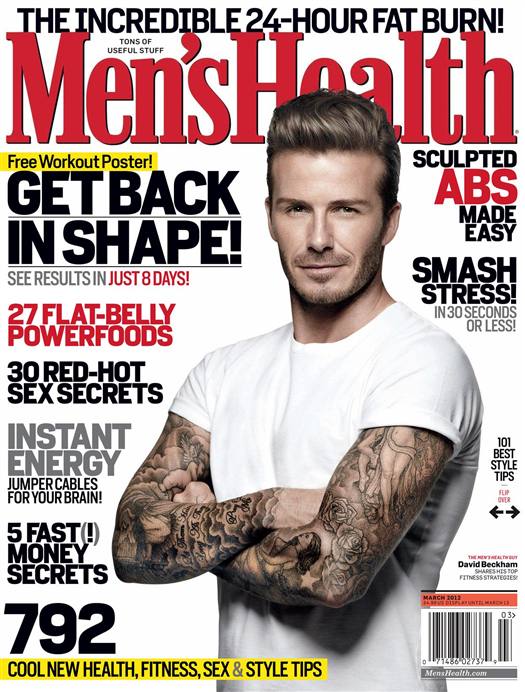
The media contributes to the construction of stereotypes about men, as well as those about women. Media images, including those on magazine covers, have portrayed men in work-related roles and women in interpersonal roles. Masculine stereotypes are often more rigid than feminine stereotypes, and when violated men are labelled ‘not man enough’ which they often consider a form of harassment. The fact men react negatively to being told they behave femininely demonstrates the stereotype about behaviours associated with women – too sensitive, weaker and powerless. Dynamic verbs used in the titles: ‘destroy’, ‘smash’, ‘blast’, are aggressive and violent. This coincides with the theory that men explicitly exemplify their masculinity, and is what the magazines are doing by encouraging machismo. Men wish to distant themselves far away from appearing feminine. Masculine stereotypes maintain hierarchy, training men to keep status and power through leadership, decision making, dominance and achievement. Paternity leave policy reflects these stereotypes.
The stereotype that the sexes do different things is apparent in the magazines, as they discuss different subjects: women and personal relationships, men and sports/health. Men’s magazines emphasise mental/physical health, lifestyle, and money and how to improve quality of life. Women’s magazines discuss health only to be attractive. Men are stereotyped here as the stressed, money making hard worker, and women are stressed about vain reasons, like what dress they are going to buy to impress a man. Men are portrayed as more interested in how to impress their dog.
Magazines, like those discussed, evoke stereotypes about the way men and women behave. Gender ideology is reinforced through everyday things, like magazines. This is why certain things in society are seen as ‘for women’ and ‘for men’. Men are capable of wearing makeup and women are capable of playing rugby. We are being conditioned unconsciously. Gender is a construction and performance, constructed by these stereotypes and gender norms.
References
Aries, E. & Johnson, F. (1983) ‘Close friendship in adulthood: conversational content between same-sex friends’, A Journal of Research 9(12): pp.1183–1196. https://doi.org/10.1007/BF00303101
Australian Men’s Health: https://assets01.magshop.com/au/assets/product/0024166_mens-health-magazine-subscription.jpeg
Butler, J. (2002). Gender trouble. London: Routledge. https://capitadiscovery.co.uk/port/items/840395?query=gender+trouble&resultsUri=items%3Fquery%3Dgender%2Btrouble
Cosmopolitan (2008): https://www.gotceleb.com/wp-content/uploads/pics/hayden-panettiere/cosmopolitan-magazine-april-2008/hayden-panettiere-cosmopolitan-magazine-april-2008-01.jpg
Cosmopolitan (2012): http://www.movienewz.com/img/story/large/megan_fox_cosmopolitan.jpg
Fairciough, N. (2013). Language and power. Retrieved from https://ebookcentral.proquest.com/lib/portsmouth-ebooks/reader.action?docID=1474620
Gill, R. (2007). Gender and the media. Cambridge: Cambridge University Press. https://capitadiscovery.co.uk/port/items/753954?query=gender+and+the+media&resultsUri=items%3Fquery%3Dgender%2Band%2Bthe%2Bmedia
Goldman, R. (1992). Reading ads socially. London: Routledge. https://capitadiscovery.co.uk/port/items/287262?query=reading+ads+socially&resultsUri=items%3Fquery%3Dreading%2Bads%2Bsocially
Gov.co.uk. Maternity pay and leave. Retrieved from https://www.gov.uk/maternity-pay-leave
Gov.co.uk. Paternity pay and leave. Retrieved from https://www.gov.uk/paternity-pay-leave
Grossman, A.L. & Tucker, J.S. (1997). Gender Differences and Sexism in the Knowledge and Use of Slang. Sex Roles, 37(1-2), pp. 101-110. https://doi.org/10.1023/A:1025644921272
Lakoff, R. (1975). Language and woman’s place. New York: Harper and Row. https://capitadiscovery.co.uk/port/items/184112?query=robin+lakoff&resultsUri=items%3Fquery%3Drobin%2Blakoff%26facet%255B0%255D%3Ddisplayascollection%253A%2522Main%2BCatalogue%2522&facet%5B0%5D=displayascollection%3A%22Main+Catalogue%22
Lazar, M. (2011). The right to be beautiful: Postfeminist identity and consumer beauty advertising. In R. Gill & C. Scharff (Eds.), New femininities: Postfeminism, neoliberalism and subjectivity (pp. 37– 51). Basingstoke: Palgrave Macmillan. https://doi.org/10.1057/9780230294523_3
Lips, H. (2013). Gender: The basics. Retrieved from https://ebookcentral.proquest.com/lib/portsmouth-ebooks/reader.action?docID=1498760
Men’s Health (2012): https://customprintingdeals.com/wp-content/uploads/2015/05/mens_health_magazine_discount.jpg
Men’s Health March (2012): https://genderstereotypes4.music.blog/wp-content/uploads/2019/12/24773-mensmagazines28629.jpg
Mills, S. (1995). Feminist stylistics. London: Routledge. https://capitadiscovery.co.uk/port/items/409515?query=feminist+stylistics&resultsUri=items%3Fquery%3Dfeminist%2Bstylistics
Mills, S. (2008). Language, gender and feminism. London: Routledge. https://capitadiscovery.co.uk/port/items/950954?query=language%2C+gender+and+feminism&resultsUri=items%3Fquery%3Dlanguage%252C%2Bgender%2Band%2Bfeminism%26facet%255B0%255D%3Ddisplayascollection%253A%2522Main%2BCatalogue%2522&facet%5B0%5D=displayascollection%3A%22Main+Catalogue%22
Mills, S. (2012). Gender matters: Feminist linguistic analysis. Retrieved from https://ebookcentral.proquest.com/lib/portsmouth-ebooks/detail.action?docID=1164304
Ringrow, H. (2016). The language of cosmetics advertising. Retrieved from https://ebookcentral.proquest.com/lib/portsmouth-ebooks/reader.action?docID=4720382
Ross, K. (2011). The handbook of gender, sex, and media. Retrieved from https://ebookcentral.proquest.com/lib/portsmouth-ebooks/detail.action?docID=818760
Rudman, L.A. and Fairchild, K. (2004). Reactions to counterstereotypic behavior: the role of backlash in cultural stereotype maintenance. Journal of Personality and Social Psychology 87, pp. 157– 76. https://www.researchgate.net/publication/8408812_Reactions_to_Counterstereotypic_Behavior_The_Role_of_Backlash_in_Cultural_Stereotype_Maintenance
Women’s Health (2013): https://www.gotceleb.com/wp-content/uploads/celebrities/olivia-wilde/women-s-health-magzine-south-africa-january-february-2013/Olivia%20Wilde%20-%20Womens%20Health%202013-04-560×733.jpg
 Gender, Language and Sexuality